Technology doesn't have to be something that divides us from nature. It can be a tool through which we can explore the natural world...


Wednesday, 3 July 2013

Red Deer River Journey - Part Four


Foothills Whitewater

 
“Friendship is the source of the greatest pleasures, and without friends even the most agreeable pursuits become tedious.” - St. Thomas Aquinas

The hamburger and fries that I had at the restaurant were delicious and seemed all the more so compared to the freeze dried meals I had been eating for days. My room wasn’t fancy, but it was comfortable and I slept soundly that night knowing that the first leg of my journey was complete.

I had a day to relax while I waited for my friends to join me. I spent the day cleaning my camera gear, charging batteries and sorting through my clothes and other gear. The next leg of the journey was to be a white water rafting trip through the foothills. This section of the river is known for its ledges and the rapids that have previously hosted kayaking competitions. Only experienced rafters should attempt this part of the river, so we hired an outfitter to guide us through these dangerous waters.

My friends began arriving at the Mukwah Tours base camp, next to the Panther River (a tributary of the Red Deer River) on that Friday evening. They set up camp and we sat by the fire drinking and talking about the next day's adventure. It was a pleasant contrast to the solitude of the previous week. I also had a chance to speak with our guides. They were all the type of young men who were drawn to outdoor adventure and extreme sports. Most of them had managed to find jobs that allowed them to maintain this lifestyle. In the winter it was snowboarding and in the summer it was rafting, kayaking and whitewater canoeing for them. One of them, who was from South Africa, also loved surfing. We found common ground when the conversation turned to preserving the river, conservation and ecology.
 
The next day turned out to be rainy and cool, perhaps the coldest day of my entire trip. After an early lunch, we prepared for the day’s rafting. We put on wetsuits, special jackets, lifejackets, neoprene gloves and helmets. After instruction in safety and paddling, we launched our raft into the swift waters of the Panther River. Shortly we found ourselves at the conjunction of the Panther and the larger Red Deer River. We were shadowed by another raft filled with neophyte paddlers and two of Mukwah’s guides. We had a single guide who drilled us briefly on rafting techniques and we were off and over our first ledge. There was excitement and nervous laughter as the water dropped out from under our raft. We watched as the other raft followed us and listened to their screams and laughter. After playing briefly in the backwaters created by the ledge, our group was on its way to the next challenging portion.
Our guide yelled instructions and steered from the back of our raft as we maneuvered our way down river through a series of ledges and rapids. Probably the most impressive of these was called “Nationals” after the National Kayaking Championship that had been held there years before. Between rapids, the other raft would challenge us to races and the South African guide would taunt us with cries of “lily dippers” and other insults whenever they managed to overtake us. We stopped for a rest and hot drinks near a twenty-five foot high cliff, from which most of us felt compelled to jump into the icy waters of the river. At the end of the day’s rafting, a van waited to shuttle us back to base camp for an evening of steaks, drinking and music.
Photos courtesy Donna Pinder

Tuesday, 2 July 2013

Red Deer River Journey - Part Three


YaHaTinda

 
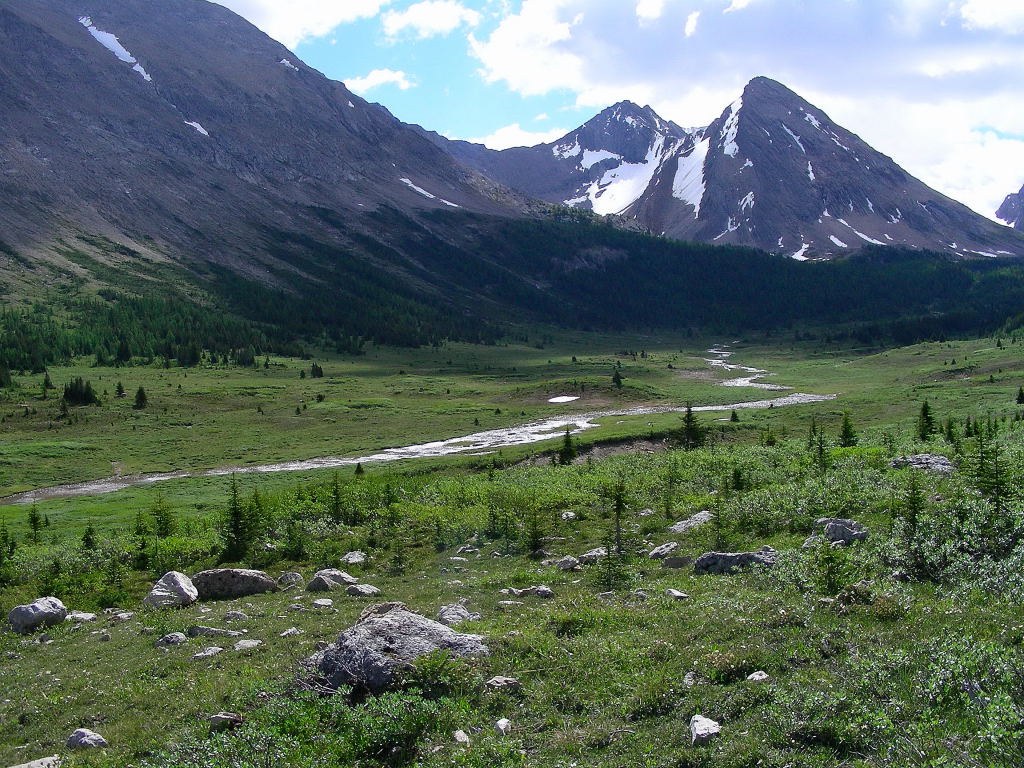
Finally after five days, I had passed through the gap between Warden Rock and Wapiti Mountain(on the eastern edge of the Rocky Mountain Front Ranges) into the wind-swept and grassy YaHaTinda or “Little Prairie in the Mountains”. The wind was still howling the next morning and I found myself tired and my body sore. My feet were blistered from hiking in wet boots and socks for days at a time. There were still about fifteen or so kilometres to the campground near Bighorn Falls and I wasn’t looking forward to trudging up the rough road ahead.


The Red Deer River flows into YaHaTinda through the gap between Warden Rock and Wapiti Mountain
I turned around to ponder the gap in the mountains(from which I had emerged) and I saw a cart coming towards me. It was being pulled by two heavy draft horses. The man holding the reins was the first person I had seen in days. His name was Tim Barton from the Outpost at Warden Rock and he stopped and asked me if I would like a ride. I certainly was glad of his offer and he took me to my destination at the Bighorn Campground in the relative comfort of what he called his “Bennett Wagon”. I thanked him and he suggested a way that I could perhaps get a ride to Mountain Aire Lodge.

After the total solitude of the last several days, I had arrived at what seemed like a very crowded and bustling location. There were trucks, trailers, horses and people everywhere. Some were campers. Others were there to ride or hike the trails of YaHaTinda or visit the nearby waterfalls. Some were outfitters and guides preparing to take their clients deep into the back country along the Cascade River Road or up into the country that I had just journeyed through. This was a busy staging area for backcountry travelers and outfitters. To me this seemed like the real Alberta. I had begun my hike in Canada several days ago and now I had arrived in Alberta.


Bighorn Falls
At Tim Barton's suggestion, I was looking for one of the outfitters. His name was Ron Warner and his outfitting company was one of the largest in the Canadian Rockies. He has been guiding in the Banff Park area for over forty years. When I told Ron that I had just hiked in from Lake Louise and that I needed a ride to Mountain Aire Lodge, he stroked his handlebar mustache and snorted out something like “that’s a long way to come in a day”. I awkwardly tried to correct my statement, but he just grunted and told me to sit and wait until his customers were saddled up and ready to go. I thanked him and I sat and watched while his men prepared the horses and loaded up the pack mules for a small party that was on its way into the Cascade and Elk River Areas of Banff National Park.
 
After this group was on its way, one of Warner’s young hired hands drove me through rolling foothills country and past the scene of a recent forest fire. We talked about his job, the ailing tourist industry and my journey. He wished me luck on the rest of my trip as he dropped me off at Mountain Aire Lodge, which sits right next to the Red Deer River on the Forestry Trunk Road.

Wednesday, 26 June 2013

Red Deer RiverJourney - part two


Red Deer Lakes

 
Every now and again take a good look at something not made with hands - a mountain, a star, the turn of a stream. There will come to you wisdom and patience and solace and, above all, the assurance that you are not alone in the world.” - Sydney Lovett

Oyster Lake - the source of the Red Deer River


The next morning I passed between Fossil and Skoki Mountains and into the drainage of the vast Red Deer River system. I made camp when I reached the Red Deer Lakes campsite and set about exploring the area.

At this point the river is not much more than a small creek. I noticed that there were small trout, probably introduced eastern brook trout in the crystal clear waters. Nestled in the valley surrounded by the summits of Cyclone, Pipestone and Skoki Mountains, and Oyster Peak, there are three Red Deer Lakes, two of which appear to drain into the Red Deer River. The other (most easily accessible) lake drains into Pipestone Creek.


One thing that I noticed immediately about the upper valley was the swarms of mosquitoes that plague the area.. I must have used half a bottle of deet that first day. This may have been the worst epidemic of mosquitoes that I have ever encountered in my Rocky Mountain travels. Usually the lack of insects is one of the things I like most about the high mountains, but this spot and the entire upper valley seem to team with the cursed parasites.

Despite the mosquitoes, the Red Deer Lakes is a very pleasant area. There were mule deer in this upper section of the valley and I found grizzly tracks and diggings. Columbian ground squirrels abound. There were also plenty of song sparrows and Oregon juncos in the region and a pair of solitary sandpipers at one of the lakes. That lake also teamed with large fish that jumped out of the water every so often, landing with mighty splashes. I wished that I had brought my fishing rod.

When I returned to camp there were some fellow hikers setting up tents and preparing dinner. I cooked up my freeze dried supper - not quite up to Skoki Lodge standards, but it was all right. Somehow I was hoping backpacking foods had improved in the years since I last tried them, but they don’t seem to have advanced much. Usually I don’t have to resort to freeze dried foods on short trips, but I had a heavy load and a longer way to travel this time.

 I retired to my sleeping pad which wasn’t that great either. How did I ever sleep on those “ins-o-lite” pads when I was younger? These air pocket sleeping pads were infinitely more comfortable than those were, but my middle aged body had a hard time adjusting to even these relatively comfortable conditions.

 
Red Deer River Trail


“The clearest way into the universe is through a forest wilderness.” - John Muir


 The next morning set a pattern for the following mornings of the hiking segment of my trip. A freeze dried breakfast and instant coffee preceded packing up everything and stuffing it all in my backpack. Then I hit the trail.

The first day was a good one. I passed the Cyclone Warden Cabin and headed eastward down the Red Deer River Trail. I crossed the river and took a side trip up a glacial creek to the Natural Bridge. The bridge of limestone frames the top of a waterfall, which has cut through the valley’s headwall instead of just flowing over it. I couldn’t resist standing on top of the bridge and looking down into the icy waters beneath my feet. I gazed back down the valley and across the Red Deer River to see part of the Drummond Glacier in the distance.

Later that day, I passed the mouth of Drummond Creek, where the milky glacier melt waters mixed with the clear waters of the upper Red Deer River, doubling the flow of the river. The glacier, mountain and creek get their names from Thomas Drummond(the first botanist to visit the Canadian Rockies). Many species of plants bear the suffix “drummondiito their scientific name, in honor of this Scotsman.

The valley below the glacier and between Mounts Cyclone and Drummond is a spectacular sight and I would have liked to explore its upper reaches. The remains of pit houses(which are believed to have been built by prehistoric hunters) have been found near the foot of the Drummond Glacier. I’m sure there is probably still much game to be found in the area. Melt water cascaded down spectacular cliffs to the valley bottom to form Drummond Creek. I waded across its icy waters, picked up the trail on the eastern edge of the valley and continued on.

That night’s camp was across the river from Douglas Lake, near a quiet backwater. I contemplated visiting Douglas Lake, but the river was high at this point and crossing it alone didn’t seem like a smart idea.

The following day was much like the day before, but I made more progress (as it was without side trips). The Red Deer River trail is a surprisingly good one considering its remoteness. The only place that I had to do any real thrashing was near Skeleton Lake, where a good deal of deadfall blocked the trail and forced me to detour through the trees. Luckily no one was around to hear my cursing. At some point I lost my bear spray when it fell out of its holster. The thought of encountering a grizzly was never too far from my mind and the loss of my “security blanket” was a little unsettling.

Later in the day I passed park warden Ivan Phillips who was traveling in the opposite direction. He had a chainsaw and said he would clear that section of the trail on his way back to the Cyclone Cabin. He is the only other person that I saw during my entire trip down the Red Deer River Trail.

I passed two sections where the force of the river has cut narrow gorges through sections of limestone. At this point the river has gathered force and volume due to the contribution of its various tributaries, entering from side valleys. It was no longer the trickling creek that I first encountered near the Red Deer Lakes. Now its mighty rumble could be heard throughout the valley. I spent some time exploring the gorge and found some beautiful yellow mountain columbine growing in the mist of its cataracts.

The nature of the forest had changed by this section of the trail. I had lost some altitude and descended from a thick subalpine forest to a sparser montane environment. The feather mosses of the upper valley are replaced by kinnick-kinnick and there are more Douglas fir and some lodgepole pine in this lower section. I saw one area where a huge herd of ungulates had passed through (probably elk). The damp ground was churned into mush by the feet of hundreds of animals passing through this part of the valley, probably on their way to higher ground.

I crossed McConnell Creek just before I made camp that evening. It was beginning to cloud over before I went to bed and the next morning I awoke to the sound of rain on my tent. I lied in bed for an hour or so, hoping that it would let up and sure enough it did. When I got out of my tent I could see snow on the mountain slopes surrounding the valley. I later received an e-mail, from the warden, saying that it had snowed at the Cyclone Warden Cabin in the upper valley. I was glad that I had only received rain - wet snow would have made the going much more difficult.

Soon I was on my way again and even after my late start, I was determined to be out of the park and into YaHaTinda by the end of the day. I crossed Divide Creek after an hour or so and looked up this side valley toward its summit. The side valley allows hikers to cross over into the Clearwater River valley and is hemmed in by Mount Tyrrell on its eastern slope. Shortly after that, I hiked out of the narrow path in the forest and onto the wider Cascade River Fire Road. This road is closed to motor vehicles and continues to the south for about 60 kilometres and emerges on the road between the Banff townsite and Lake Minnewanka. It allows those on foot or horseback to access the remote Banff Park Front Ranges and a network of rugged hiking trails. I was at a turn in the road where it headed east, following the Red Deer River valley to YaHaTinda. I embarked on the road and over Tyrrell Creek, through a burned out forest toward a growing gap in the mountains ahead of me. Soon I was out of Banff National Park. I found a bleak, windy spot where I made a makeshift camp and retired for the evening, hoping my tent wouldn’t blow away in the night.

Following the upper Red Deer River through the front ranges of the Rocky Mountains while carrying a heavy pack and video camera had certainly been an arduous task. Traveling solo through the wildest area that I have ever visited was at once a beautiful but haunting experience. My only regret was that there was little time for side trips and to explore the surrounding valleys, lakes and ridges.
 
next time YaHaTinda

Tuesday, 25 June 2013

Red Deer River Journey


It's hard for me to believe that it has been ten years since I began my journey down Alberta's Red Deer River, but on June 27, 2003 two friends of mine dropped me at the trailhead near the Lake Louise ski hill. I have told the story of my preparations and that first day many times as a prelude to presenting my film "Red Deer River Journey' to various groups. Let's just say things didn't begin as planned. Between an injured back, forgetting my hiking boots and an overweight backpack there were challenges right from the start and it almost didn't happen at all.

A lot has happened since that time. In 2005, the river flooded changing its character and its course for ever. In the spring and summers since, the river has run higher than it did in the preceding years. The June goldeye fishing (that I traditionally did every year) isn't possible most years. I doubt that a journey like the one I took ten years ago would be possible at all (on many of the years since). Even as I write this, the river has flooded its banks again. The Bow and Elbow Rivers have flooded my hometown of Calgary and created an almost unimaginable disaster for the people of Southern Alberta. My beloved Highwood River has overflowed its banks yet again. This time the Town of High River has been totally engulfed and its residents have been evacuated.

In June of 2012, a pipeline burst just downstream of Sundre - dumping 3000 barrels of sour crude oil into an otherwise pristine section of the Red Deer River, threatening Glennifer Lake reservoir and the water supply for the City of Red Deer. Perhaps this year's flooding will help to wash the remaining oil from the banks and side channels.

With all of these reminders of how powerful the forces of rivers can be and how they affect all of our lives, I thought I might revisit a story that I wrote about my adventures on the Red Deer River. It's a long story, but I will post each section one-at-a-time with some italicized updates. I hope you will enjoy it.


Iconic view of the Red Deer River at Dry Island Buffalo Jump Provincial Park
 
 Red Deer River Journey
“To hear is to forget. To see is to remember. To do is to understand” - Chinese proverb
 
I have lived in Alberta for most of my life and the Red Deer River has always fascinated me. As a boy, I dreamed about canoe trips along its waters. Its badlands captured my imagination and viewing the fossils found along its banks inspired visions of becoming a paleontologist. As an adult I visited the Dry Island Buffalo Jump, Midland and Dinosaur Provincial Parks. I explored the Hand Hills and YaHaTinda. I fished the “West Country” for trout and whitefish and the river’s middle section for goldeye and walleye. I found myself living near the Red Deer River and working in the city that bears its name. I have seen the river valley in its many different states and in every season of the year. I have learned even more about the river’s nature by my association with the Red Deer River Naturalists.
I’m not sure where the idea of traveling the Red Deer River’s entire length came from, or when I first thought of making the journey. I became inspired to finally make the trip when I was in the Wells Gray area of central British Columbia. I discussed the idea with a member of the Kamloops Hiking Club, while I was visiting the Trophy’s Lodge. He urged me to make the journey “before it was too late”. I am middle aged and the days of my being able to complete a voyage like traveling the entire Red Deer River, were certainly numbered (as I was to find out when I attempted the trek).
Much planning and research were needed before I would be ready. The decision to record the entire trip and perhaps make it into a film made things even more difficult, but by the end of June 2003 I was ready to begin my journey.
The Mountains
Skoki Lodge
“A journey of a thousand miles must begin with a single step.” - Chinese proverb
 
It was June 27, 2003. After work, two of my friends drove me up to Lake Louise, where we stayed for the night. After planning everything for months and organizing my equipment into groups for the different legs of my trip, I realized that I had left my hiking boots at home. I was a little apprehensive at this point and this caused me to worry out of all proportion to the size of problem. What else had I neglected to do?
We got up early the next morning, had breakfast and waited for the local sporting goods store to open. Luckily they had some very decent light weight boots for sale. In the old days, new boots would have been a problem on a long backpack trip, but modern methods and materials used in the manufacturing process create boots that require very little breaking in.
We met up with the Skoki Lodge/ Lake Louise Ski Hill bus at the Fish Creek parking lot. I lifted my heavy backpack up to the young and athletic young driver atop of the van and my friends wished me luck before I climbed aboard for the drive up the access road to Temple lodge. We passed a grizzly sow and her two cubs along the way and picked up two frightened hikers. I hoped that I wouldn’t be encountering any more bears once I was on foot.
The bus left me and several other hikers at the end of the access road and I began a slow ascent, through subalpine forest to aptly named Boulder Pass. At the summit of the pass I found myself on the western shore of Ptarmigan Lake( where I stopped for lunch). I gazed back across the Bow Valley toward Mount Temple. I could hear the “eeeeeeep” of the Pikas who scrambled about the scree slopes of the pass area. They were busy going about their daily routine of gathering vegetation for their various stashes, hidden among the rocks. As I prepared to continue on, I noticed a Clark’s Nutcracker gliding down to the pass from the summit of Ptarmigan Peak to my left. These gray and white birds with black wings like the high alpine environs and are usually associated with the white barked pines that grow at high altitudes. They are named for the famous American explorer, William Clark.
I continued hiking around the north shore of Ptarmigan Lake and through a thoroughly alpine landscape. There were still patches of snow to be negotiated at this time of year. At one point, while crossing a patch, I put my foot through the crusty surface and found myself with one leg in wet snow up to my crotch. This was made more difficult by my heavy backpack and video camera and I was afraid that I had hyper-extended my knee. I managed to struggle out of this awkward position and continue on with no injury.
In this part of the mountains, it was early in the hiking season and there was a possibility that your way could be blocked by snow at the high passes. I was happy that this was not the case on this occasion, as I veered northward and began my ascent to Deception Pass. I threw down my heavy burden when I reached the summit and looked back down the Ptarmigan Valley, past Boulder Pass and towards the Main Range summits near Lake Louise. The view ranked high with some of the best that I had experienced in the Canadian Rockies, and I paused for a while to rest and take it all in. There is plenty of room for further exploration and I plan on revisiting this region again one day, with a lighter pack and more time.
View from Deception Pass
The summit of Deception Pass is at an altitude of 2485 metres. This was the highest point of my trip and I joked to myself that it was all downhill from there. One of the inhabitants of this high mountain pass was a hoary marmot, who appeared briefly to have a look at me while I rested. His whistle rang out, echoing off of the surrounding peaks and he disappeared from view. I began a gradual descent into the Skoki Valley and soon I was back among the trees and drawing close to the day’s final destination.
Hoary marmot
 
While I was planning out my trip, I noticed Skoki Lodge on the backcountry maps. One of the proprietors of my local outdoor shops suggested, that( if I stayed at the lodge)  I would be eligible for the bus ride up the initial access road to Temple Lodge. This alone sold me. I found Skoki Lodge to be a pretty good deal. Factoring in the comfortable surroundings and a soft bed, along with breakfast, supper and a bag lunch, this little bit of luxury at the beginning of my journey was well worth the extra expense and I was glad that I had booked myself a room. It was the best night’s sleep that I would have for a few days…
next time Red Deer Lakes


Sunday, 10 June 2012

Jackson Creek Oil Spill

Last Friday afternoon (along with concerns about more rain in the Rocky Mountain Foothills) came the news that there had been an oil spill (caused by a ruptured pipeline) along Jackson Creek - a tributary of my beloved Red Deer River. I got home from work and began to look for information in the internet. There were pictures of a huge oil slick on the Gleniffer Lake reservoir and various articles about the size of the spill, which seemed to settle at the 3000 barrel mark. Hour by hour you could see the propaganda machine at work as articles originally entitled "Another Alberta Pipeline Rupture" were spun into "Alberta rushes to Respond to Oil Spill" and "Oil Spill Contained". Alberta Premier Allison Redford made an appearance in Dickson with her new environment Minister in tow.
I decided that I would take a drive out to Jackson Creek and see if I could see anything for myself. I arrived at the Garrington Bridge which is the first bridge across the Red Deer River downstream of the mouth of Jackson Creek. I hadn't expected to see much and I didn't as the muddy waters of the Red Deer were high up on the riverbanks. I continued west and then turned south on Alberta's "Cowboy Trail" (Highway 22) towards Sundre. When I got to what I figured must be Jackson Creek, I looked at the waters and they seemed to be fine where they crossed the highway. I took the next township road east and then the next range road north to intersect the creek once again.
 A beautiful great blue heron flew up in right in front of me when I stopped to look at the creek. No matter how jaded I get, I still appreciated the impressive sight and I couldn't help smiling, until I remembered why I was there...
I took the next township road east and it took me parallel to Jackson Creek and into the valley of the Red Deer River. I remembered this place. Nine years ago I canoed along this section of the river. It was a special place. Small creeks and springs flowed into the river. Herons and other wading birds dotted the marshy west bank. There were muskrats and beavers in the waters and on the banks. Swallows and other songbirds were in the air as I hurtled along the river with a huge grin on my face no doubt. It was a wonderful evening and I promised myself that I would come back for further exploration one day.
I certainly hadn't thought that I would be returning under these circumstances. The road ended just short of the Red Deer River itself. I got out of the Jimmy and walked past a couple of oilfield vehicles to see a pond full of oil. I shot some video of the mess and after a few minutes a cameraman came along with a broadcast camera on a tripod with a man and woman. He appeared to be a stringer for CTV and he was setting up for a remote interview. I could hear bits and pieces as the man talking to the CTV reporter by cell phone.
 "...our entire way of life has been lost..."
He also told the interviewer that he himself worked in the oilfield business - for another pipeline company no less. It's Alberta after all and most of us owe at least some of our livelihoods to the oil industry, one way or another.
I scrawled my name and number on a makeshift business card. "Phil French - President Red Deer River Naturalists". I asked to interrupt for just a minute and introduced myself. I looked into the man's face as I handed him the card and I could see a deep sadness in his eyes. His face looked so drawn and tired that I hesitated for a moment, then I told him "I don't know what we can do, but if there's anything please don't hesitate to call us". The man and his wife both gave me an unexpected and appreciative smile and he thanked me. Perhaps he will call...
I spun the Jimmy around and headed for home as the rain began yet again. I thought about the pouring rain and all that oil and I felt a tight feeling in my stomach. Would this special place ever be the same? I thought about the faces of the beleaguered looking couple and my heart sank. Would their lives ever be the same? The rain began to pour harder as I continued east toward my home.

Wednesday, 15 February 2012

Winter Birds

" ...no two seasons are ever the same and if you look closely you will see different things every winter"

Snowy owl on a power pole
A common winter sight

I admit it. Winter isn't my favorite time of the year. I often find myself depressed and fed up after days of cold and blowing snow. My eyes and heart long for the color and life of the other three seasons. One thing that brings me solace during these dark days is the birds at our feeders. So colorful and full of life, they always make me smile and often fill me with wonder at their hardiness.
My winter walks in the countryside are quiet affairs. One really has to look hard to see any living thing, but each small prairie town is an oasis of life during these cold months. You can hear the chatter of birds squabbling at the feeders and amongst the fruit trees and berry bushes. Periodically you can hear the twitter of bohemian waxwings as the raid the mountain ash and my decorative crab tree. Some years, the black-capped chickadees start their song almost immediately after Christmas. I always like to imagine they are singing "spring's coming! Spring’s coming!"
There are always woodpeckers to watch. The downy and larger hairy woodpeckers are constantly at the suet. It seems as though there is always one northern flicker that overwinters in my yard. It can vary from the red-shafted or yellow-shafted races, as we live in an overlap in their territories. Sometimes if you look closely you will find a hybrid. This year it is a red-shafted flicker. In early winter I can watch the upside-down antics of one of my favorite birds; the white-breasted nuthatch. I see them less in the latter half of the season.
One thing I have learned from living in the country is that some birds actually migrate here for the winter. Most Decembers bring the redpolls. The "common" come from the boreal forest and the "hoary" redpolls from the arctic tundra. The snow buntings also move onto the prairies. They never feed at my feeders, but can be seen in open fields in large flocks as I drive along the backroads and highways.
Female pine grosbeak
Another thing I have learned from watching nature over many years is that no two seasons are ever the same and if you look closely you will see different things every winter. The obvious example of that is the weather. Some winters (like the last one) are long and bitterly cold and then some are like this one and are very mild. Some years there are no redpolls. One year we had a junco overwinter at our feeders and on another year an American tree sparrow. One winter (much to my surprise) there was a female cardinal that returned several times to my feeders. Once I observed many short-eared owls in a frozen marsh near my home. It was 30 below zero and I filmed them as they dived into the snow hunting for rodents. This winter there have been a flock of pine grosbeaks at my feeders. One of them is a gaudy red adult male. The rest are females and immatures. It's the first time this has occurred in the eighteen years that I have lived here. 


Male pine grosbeak
I drive many miles as part of my employment and I usually see a few snowy owls over the course of the winter. This year I have seen them every time I go south onto the prairie near Three Hills or Drumheller, Alberta. It's a reminder that there are patterns in nature that are larger than the human experience. Wheels within wheels, the cycles of our planet may be revisited over and over with the coming of the seasons or just once in a generation or even longer.

Wednesday, 11 January 2012

Tale of a Cavity Nest

"I was the camouflaged predator... she was Arnold Schwarzenegger "
A couple of springs ago a friend of mine, Jim Potter called me and said "I've found a pileated woodpecker nest on my property, would you like to come by and shoot some video?" Of course I said yes. It would be perfect for a project Jim and I were working on entitled "Inside the Box" - a film predominately about cavity nesting ducks. He took me out to the woods and after I set up my video camera, he tapped an old dead poplar snag and from an elongated hole high up on the tree popped the head of the female. We made plans to return to the nest later.

Weeks later he called me and took me out to the pileated nest again. This time he left me there alone with my video camera and went back to his house. I was in full camouflage and I was careful to remain quiet and took care to never look directly at the nesting cavity, but instead looked down into my viewfinder. After a short wait one of the young stuck his head out of the hole and began to call. I could hear the parents returning its call from back in the woods. My patience paid off and I got some good footage of the comings and goings of both parents as they took turns feeding grubs to their three offspring on that hot summer afternoon.
Male Pileated Woodpecker feeds offspring (from video)

Even though I remained silent and was careful not to reveal myself, I could tell that the wary birds knew something was up. They were careful not to take their beady eyes off of me. After the final time the female fed her young she flew just to my right. I heard the rustle of leaves to my immediate right. I thought she might have landed in a tree, but I didn't dare look - I just waited quietly, listening. After a long while, I decided that I had enough footage anyway and that I would have a look and see if the mother woodpecker was sitting there. I turned to my right and... It reminded me of a scene from the movie "Predator". I was the camouflaged predator... and the woodpecker...  she was Arnold Schwarzenegger staring back at me - her beak several inches from my nose! We both started and the bird turned inside out and flew off into the woods. It was one of those things I will never forget.
Goldeneye duck (photo courtesy Myrna Pearman)


In my film I noted that "perhaps next year a goldeneye duck will use the cavity for its nest". Sure enough the very next summer that's exactly what happened. Jim invited me out there again, but by the time I managed to get there the ducks were gone. They had fledged. Instead (to our surprise) the third inhabitant of the cavity emerged - a northern flying squirrel. Last weekend Jim took a few of us for a walk across the ice of his frozen ponds to check the old dead poplar tree once again. This time three flying squirrels poked their faces out of the hole. Jim told us that while they didn't hibernate, they were relatively inactive during the winter and would stay together in tree cavities for warmth. They are fairly common in Alberta, but are not often seen because they are nocturnal.

Flying Squirrels in winter (from video)
I think this procession of birds and mammals illustrates just how precious natural cavities are to these wild creatures.

Is there a moral to this story? A friend and neighbor of mine, Gordon Green has been farming the country along the edge of Alberta's Red Deer River Valley for most of his long life. He tells his grandchildren that if they want to be farmers they should always remember to "leave some room for God's creatures".  I couldn't say it any better than that.